

Your tests came back normal.
You still don’t feel right.
We treat the structural cause most doctors never check: the ligaments of the upper neck.
- Non-surgical
- No needles
- No drugs
“One of those good hurts.”how patients describe the feeling
Call the Office: (856) 740-5065Sicklerville, New Jersey. Open Monday through Thursday 11am to 6pm, Friday 12pm to 4pm.
Does this sound like you?
- Your heart races when you stand up.
- You get dizzy or lightheaded out of nowhere.
- Brain fog makes it hard to find words or focus.
- Your joints slip, pop, or dislocate.
- Your neck aches no matter what you try.
- You’re exhausted, and sleep doesn’t fix it.
- It all started, or got worse, after a car accident.
- You’re in good shape, but you crash after workouts.
- Every test comes back “normal.”
If you kept nodding as you read that list, keep reading. There may be a structural reason for what you’re feeling, and it doesn’t show up on standard tests.
Sound like you?
You don’t have to figure out the rest alone. Call and talk it through with our office.
Call the Office: (856) 740-5065You’ll reach our staff. A few questions, no pressure. Open Monday through Thursday 11am to 6pm, Friday 12pm to 4pm.
What is SWAVE?
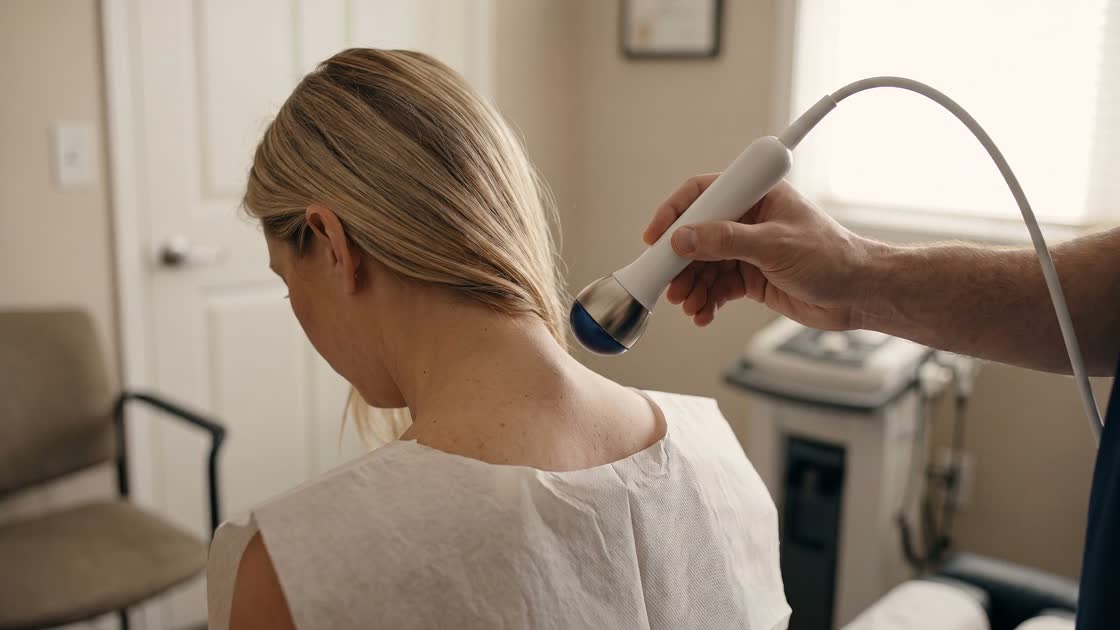
SWAVE stands for Sound Wave Acoustic Variable Emission. It uses focused acoustic sound waves, the same category of technology medicine has used for decades to break up kidney stones.
But instead of focusing the waves to break something down, SWAVE expands them to help build tissue up. The waves are designed to stimulate blood flow and your body’s own collagen production, with the goal of strengthening the ligaments of the upper neck.
- Non-surgical
- No needles
- No drugs
- No downtime

Why the neck?
Picture your head as a grapefruit balanced on a pencil. The only things holding it steady are the ligaments of your upper neck.
When those ligaments are too weak or too loose to do their job, the top two vertebrae can shift out of place. Those bones sit right next to the vagus nerve, which helps control your heart rate, digestion, and blood pressure. They also sit beside the arteries that feed your brain.
When shifting bones put pressure on those structures, the result can look like a long list of symptoms that seem unrelated: a racing heart, dizziness, brain fog, gut problems, crushing fatigue. That’s why so many people bounce between specialists for years. Each doctor is looking at one symptom, not the structure that may be driving all of them.
Who we help
Ehlers-Danlos & Hypermobility
EDS is genetic, and we’ll be honest with you: it can’t be cured. Genetically loose ligaments struggle to stabilize the neck. SWAVE doesn’t change your genes. The goal is to strengthen the specific ligaments that hold your upper neck steady.
POTS & Dysautonomia
Racing heart when you stand, dizziness, brain fog, digestive issues. When upper-neck instability irritates the vagus nerve, it can disrupt the automatic systems your body is supposed to run on its own.
Car Accidents & Whiplash
In a crash, neck ligaments can be overstretched in an instant and never fully recover on their own. Symptoms sometimes show up months or even years later, long after everyone stopped connecting them to the accident.
Athletes & Overuse Injuries
Thousands of reps of the same motion wear down the same ligaments. Strong muscles can mask weak connective tissue until the crashes, pain, or strange symptoms start showing up.
Seeing what other scans miss: the DMX
Standard MRIs and X-rays are still photos, taken while you lie perfectly still. But instability is a movement problem. A still photo of a moving problem often looks normal.
The DMX, a digital motion X-ray, is a moving X-ray video of your neck, recorded while you actually move it. It can reveal instability that other scans missed.
Evaluation always comes first, and not everyone who gets a DMX turns out to be a candidate for SWAVE. We’ll tell you honestly what we see.

Read the research yourself
You’ve probably done more reading about your condition than most people ever will. Keep going. Below is a reading list we keep updated: peer-reviewed studies on the science this work is built on, each one linked to PubMed, the National Library of Medicine’s database, so you can read it yourself.
To be clear about what these are: studies of the underlying science, like acoustic wave therapy, tissue healing, and upper-neck instability. They are not studies of SWAVE itself, and none of them is a promise about your results.
Patient stories
Real patients, in their own words, shared with permission. Tap a video to play it.
Aurelia’s six weeks
When Aurelia came in she could barely walk and needed family to help her through the day. These two videos are her first treatment and her last.
These are individual experiences, told in each patient’s own words. Every person and every condition is different, and no video is a promise about your results.
Want to talk to people who get it?
The SWAVE Community is a private Facebook group where patients and people exploring treatment share experiences, ask questions, and hear news from the office first. Free to join, and your posts are only visible to members.
Join the SWAVE CommunityWhat to expect
-
1
Call the office
Talk to our staff, ask anything, and set up a visit. (856) 740-5065
-
2
Come in for an evaluation
A thorough exam and imaging, including the DMX when appropriate, to look for upper-neck instability.
-
3
Review your results
We walk you through what we found, in plain language, and whether you’re a candidate for SWAVE.

About Dr. Benn
Dr. Benn has spent more than 25 years in practice, and he developed SWAVE because he kept meeting the same patient: someone with very real symptoms, a folder full of normal test results, and a string of doctors who had stopped looking.
For him, this work is personal. His own daughter lives with this condition. He knows what it’s like to watch someone you love be told it’s all in her head, and he built this practice for the people still being told that.
Our mission
SWAVE exists for people living with complex, often invisible conditions: connective-tissue disorders, Ehlers-Danlos syndrome, POTS, dysautonomia, and mitochondrial disease. We practice compassionate, non-invasive, patient-centered care.
We listen, because patients know their bodies. We believe symptoms are real, not “all in your head.” Our mission is to bring understanding, hope, and a clearer path forward to people who have too often been dismissed.
Adam J. Benn, D.C., Founder of SWAVE USA